Inside AquaStar Laboratories: What APSP-16 Robot Testing Means for a Drain Cover
A drain cover is a part you hope is never tested in the field, so its proof happens in a lab first.
October 28, 2026 · 4 min read
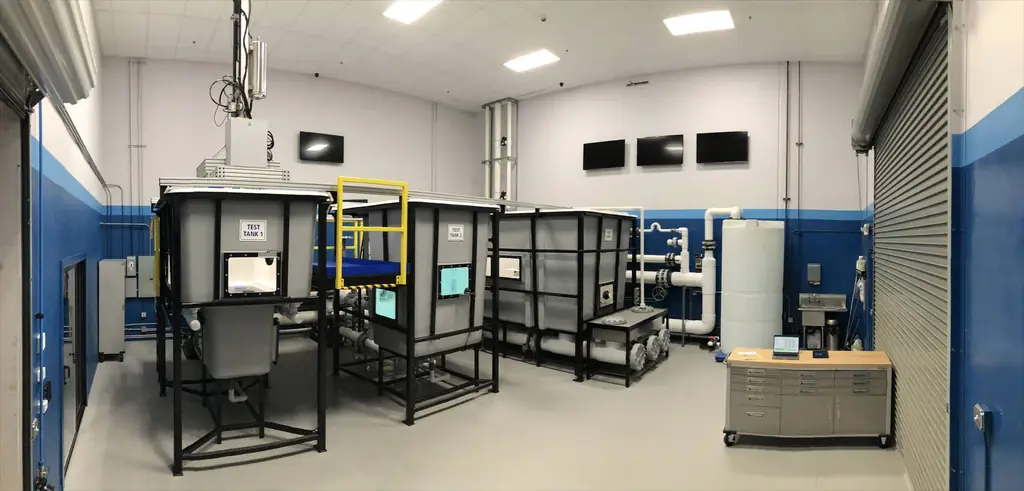
A drain cover is a part you hope is never tested in the field. That puts all of its proof before the sale, in a lab. AquaStar runs its own, called AquaStar Laboratories, and publishes specific details about what happens there. Its slogan for the category is "A safe drain is no accident.®" This article looks at those details and at what they mean when you are the one specifying a cover.
What the lab says it does
AquaStar describes its lab work in two lines. The first is "Robotic APSP-16 testing to improve repeatability, precision, and accuracy." ANSI/APSP-16 is one of the standards AquaStar lists for its drain covers, alongside Virginia Graeme Baker Act compliance and CPSC. A test run by hand varies a little from one operator and one day to the next. A robot repeats the same motion the same way, so differences between results come from the design and not from the person.
For a drain cover, repeatability matters because a design is changed and tested over and over. If the testing itself drifts, the engineer cannot tell whether a change helped. A robot removes one source of noise, and that is what AquaStar means by repeatability, precision and accuracy.
What ± 0.25% flow measurement means
The second line is about measuring water. AquaStar says its lab has high accuracy flow measurement, ± 0.25%, from 0.94 gpm to 9,792 gpm, using electromagnetic flowmeters in 2, 6 and 10 inch sizes, with in-house calibration accurate to ± 0.00016%. Three meter sizes are there because a meter reads best near the middle of its range, so small flows go through the small meter and large flows through the large one.
The plus-or-minus figure is the error band. If the figure applies to the reading, a result of 100 gpm would be good to about a quarter of a gallon per minute either way. An electromagnetic meter has no moving parts in the water path, which is one reason this type is used for careful work. The small calibration figure matters because a meter is only as good as the reference it was set against.
Why does this reach the person buying a cover? A flow rating printed on a cover is only worth as much as the measurement behind it. A tight measurement band means the rating should reflect what the cover actually did on the test loop and not a rounded estimate.
Why test in-house on top of third-party
Third-party certification is a pass or fail verdict on a finished design. AquaStar's own position on it is direct: "While third-party testing and certifications confirm a product is able to pass VGBA requirements, only through in-house testing can each design be optimized." The point is that a lab you control lets you run a design, change one thing and run it again until the numbers improve, long before anyone outside sees it.
What the rating on a cover tells you
Entrapment is the hazard a suction outlet cover is designed against, and the rating on the cover is the number that ties the part to the system. In general terms, a cover is rated for a flow, and the water the pump can pull through that outlet has to stay within that rating. Pipe size, pipe orientation and sump depth all influence how the cover performs, which is why a cover cannot be chosen on diameter alone.
AquaStar's range covers round covers in 6, 8, 10 and 20 inch sizes, square covers in sizes from 9 to 24 inches, and a 32 inch channel drain, for gunite, vinyl and fiberglass pools. It also makes low-profile circular drains with a water stop, sold as Full Circle®, Perfect Circle® and Eclipse™. On its website, an advanced drain search filters by pipe orientation, size, sump depth and flow rate, and the database behind it holds 90 drain cover specification records.
Questions to ask before you specify
- What flow rating does the cover carry, and does it fit the most flow the pump can send through that outlet?
- Is the cover listed for the pipe size and orientation in the plan?
- Does the sump depth match what the design assumes?
- Which standards does the cover list, such as VGBA compliance, ANSI/APSP-16 and CPSC?
- Who confirms the final design with the local authority?
That last question matters because requirements differ from place to place. The designer and the local authority decide what applies to a given pool, and nothing in this article replaces them. What a lab like AquaStar's gives you is a part with a documented, repeatable record behind its rating.
AquaStar also offers a free handout for pool professionals, titled "Key Steps to Enhancing Pool Safety," in quantities of up to 100 copies. If you work with owners, it is a practical way to start the drain conversation. For help matching a cover to a system, call the Ventura office at (877) 768-2717, Monday to Friday, 7:30 AM to 4:30 PM.
AquaStar Pool Products, (877) 768-2717
Call (877) 768-2717More articles
Pipeline Filter PLF27000 or PLF35000: Choosing, and Why Core Height Matters
A filter order goes wrong quietly, and a customer review of a mismatched core assembly shows exactly how.
What a Variable-Speed Pipeline Pump Changes on the Electric Bill
AquaStar says running a Pipeline Pump at half speed uses only 1/8th of the electricity, and the physics behind that claim is worth understanding.