What a Variable-Speed Pipeline Pump Changes on the Electric Bill
AquaStar says running a Pipeline Pump at half speed uses only 1/8th of the electricity, and the physics behind that claim is worth understanding.
October 28, 2026 · 4 min read
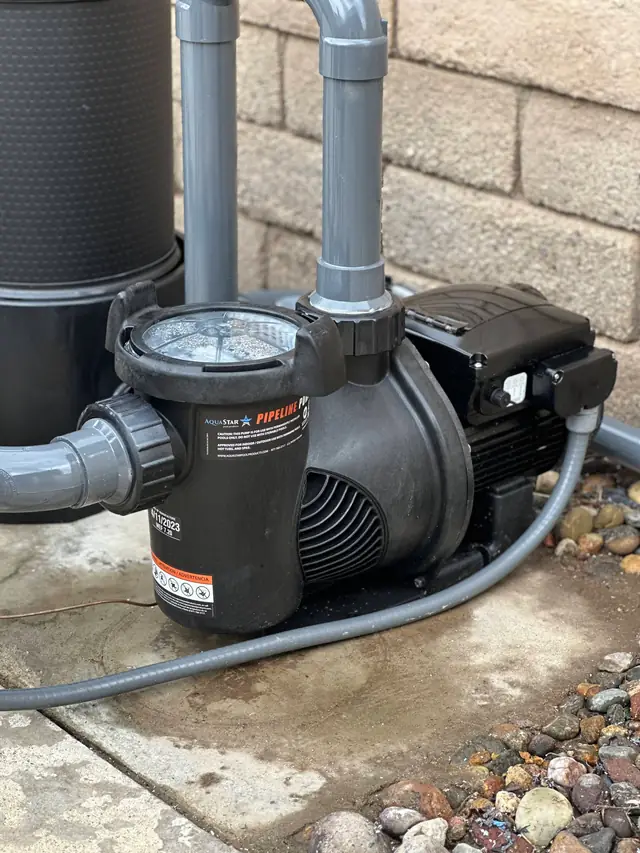
The pool pump is usually the biggest electrical load on the equipment pad, and for years it ran the same way: one speed, all day, whether the water needed it or not. A variable-speed pump breaks that habit. AquaStar's Pipeline Pumps® are variable speed, offered in 1-1/2 HP and 3 HP versions, and the company puts one claim ahead of the rest: "Running the pump at half speed consumes only 1/8th of the electricity."
Why half speed is not half the power
The claim sounds too good until you meet the pump affinity laws, which describe how a centrifugal pump behaves when you change its speed. Flow changes in step with speed. Pressure changes with the square of speed. Power changes with the cube of speed. Cut the speed in half and the flow drops to half, but the power falls to one half times one half times one half, which is one eighth. That matches AquaStar's line.
A caution belongs here. Those laws describe an ideal system. In a real pool, the savings depend on the pipe size, the state of the filter, how high the water has to climb and what else is on the line, so treat 1/8th as the figure AquaStar states for the pump rather than a promise for every pool. Your electric rate and run hours change the dollars, and this article does not put a number on them.
The useful part is the arithmetic of time. Run the pump half as fast for twice as long and you move about the same volume of water. The energy is one eighth, doubled, which is a quarter of the original. That is the reason slow and long beats fast and short for routine filtration.
What the Pipeline Pump gives you to work with
- Four programmable speeds, 800 to 3400 RPM.
- A permanent magnet motor, listed with a TEFC enclosure.
- Versions in 1-1/2 HP and 3 HP.
- An RS485 port for connecting controls.
- A noise claim from AquaStar: "So quiet, you'll wonder if it's on."
TEFC stands for totally enclosed, fan cooled. It means the motor windings are sealed away from the air around them and a fan on the motor shaft does the cooling, which suits an equipment pad that sees dust, damp and the occasional splash. A permanent magnet motor is the type most variable-speed pumps use because it holds efficiency at low speeds. Ask your distributor which controls pair with the RS485 port, since that depends on what you want to connect.
Setting speeds for filtration
Daily filtration is the job where a variable-speed pump earns its keep. The general approach is to find the lowest speed that still gives a steady flow through the filter and keeps surface water moving toward the skimmer, then run it for longer hours. Slow flow also lets the filter hold fine particles better than a hard, fast push does, which is one more reason low and long is the common practice.
Anything else on the pad that needs a minimum flow sets a floor on how low you can go. A heater, a sanitizer cell or an ozone injector each has its own requirement, so check each device's instructions before you program the lowest speed. AquaStar's PureStar™ ozone unit, for example, has its own activation behavior, covered in another article on this blog.
Setting speeds for cleaning and features
Some jobs need more water than daily filtration does. A suction cleaner such as AquaStar's CyberStar® needs enough flow to work, and its own instructions set that number. Waterfalls, spa jets and a deep vacuum session all fall in the same group. This is where the higher programmed speeds are for.
The discipline is to give those jobs the speed they need and no more time than they need. A higher speed for a cleaning window, then back down to the base speed, keeps the bill closer to the ideal that the cube law promises. Leave the high speed running all day and you have rebuilt the old single-speed pump with a nicer motor.
Before you swap a pump
- Note the horsepower of the current pump and the pipe size on both sides of it.
- Check the filter's condition, because a loaded filter raises resistance at every speed.
- Ask your distributor which Pipeline Pump version suits the system.
- Have a licensed electrician confirm the circuit and wiring before the new pump goes in.
- Write down the speeds you program, so the next tech does not have to guess.
AquaStar also sells the pump as part of a bundle it calls The New 3: a Pipeline Pump, a Pipeline Filter and PureStar ozone, which the company describes as "the most efficient pool system on the market." That is AquaStar's claim about its own system. AquaStar publishes no prices, so the numbers come from your distributor, and the savings come from how you program the pump after it is installed.
AquaStar Pool Products, (877) 768-2717
Call (877) 768-2717More articles
Pipeline Filter PLF27000 or PLF35000: Choosing, and Why Core Height Matters
A filter order goes wrong quietly, and a customer review of a mismatched core assembly shows exactly how.
Inside AquaStar Laboratories: What APSP-16 Robot Testing Means for a Drain Cover
A drain cover is a part you hope is never tested in the field, so its proof happens in a lab first.